Gagosian, 20 Grosvenor Hill, London
January 15–March 14, 2026
Opening at the Grosvenor Hill gallery in London
on January 15, 2026, Facing West is curated by the photographer’s granddaughter, Caroline Avedon.
In the American West, an extended series commissioned by and first exhibited at the Amon Carter
Museum in Fort Worth, Texas, celebrated its fortieth anniversary in 2025. At the time of its debut in
1985, Avedon was well known for fashion photography, portraits of people in power, and his work
with the civil rights movement. These images, which picture the heart and soul of hardscrabble,
working-class America, represented a significant new development in his work.
Avedon spent five years, from 1979 to 1984, traveling to twenty-one US states. He conducted more
than a thousand sittings, finally producing 126 editioned images, 21 of which are on view in London.
With the help of introductions made by an assistant, Laura Wilson, he selected a wide variety of
people to photograph, representing a range of professions and rural pastimes, and depicting oftenoverlooked subjects from drifters to coal miners.
Regarding his portraits as subjective interpretations
(“All photographs are accurate,” he stated. “None of them is the truth”), Avedon often confronted
suffering but succeeded in conveying the hidden strength of his subjects, instilling the project with
a sense of hope. Seeking human connection, he stood outdoors and next to the camera to engage
with his subjects who, in a departure from the conventions of series portraiture, he also named and
defined, resisting both generalization and idealization.
Using an 8 × 10 Deardorff camera, natural light, and scant props, Avedon photographed his sitters
against a white backdrop, retaining the black border from the film negative edge to emphasize the
images’ absence of compositional manipulation. He also explored new methods of presentation,
mounting the prints on aluminum.
Caroline Avedon’s selection of images moves from darkness
to light—from hardship and labor to youth and hope—and highlights some lesser-known shots to
emphasize a diversity of experience for a new generation.
Among the works’ subjects are coal miner James Story, whom Avedon compared to Saint Sebastian
for his embodiment of both strength and innocence, and Richard Wheatcroft, a rancher from Jordan,
Montana, whom Avedon photographed twice (in 1981 and 1983), and with whom he developed a
friendship. In a diptych of Wheatcroft, the subject appears at first glance to have barely changed
in the two years between shoots, though closer inspection reveals the subtle wear of intervening
life experience on his stance, clothing, and face.
Inspired by Avedon’s method of emotional
storytelling through sequence and contrast, the curator also establishes thematic pairings throughout
the exhibition, creating narrative links and renewing a dialogue around identity, class, and the
complexities of the American experience.
Avedon’s In the American West book was the focus of an exhibition at Fondation Henri Cartier-Bresson
in Paris in 2025, marking the publication’s fortieth anniversary; the exhibition will travel to additional
venues in 2026–27. To commemorate the milestone, Abrams has also released a special reprint of thebook.
To read Avedon's biography and see many.many more images go to: https://gagosian.com/artists/richard-avedon/
IMAGES
Copyright 1985 by Richard Avedon Inc. \ All rights reserved. \ This photograph was printed in 1985. \ James Story, coal miner \ Somerset, Colorado, 12/18/79 \ This photograph was printed for and first exhibited \ at the Amon Carter Museum, Fort Worth, Texas \ September 14 - November 17, 1985.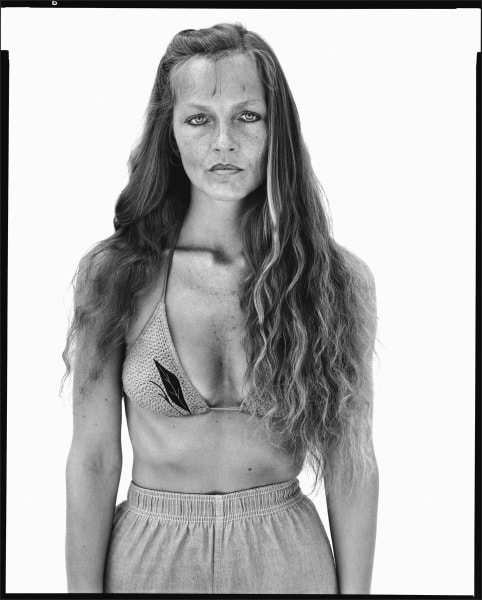
Richard Avedon
Charlene Van Tighem, physical therapist, Augusta, Montana, June 26, 1983
© The Richard Avedon Foundation
Courtesy Gagosian
-

Richard Avedon
Unidentified migrant worker, Eagle Pass, Texas, December 10, 1979
© The Richard Avedon Foundation
Courtesy Gagosian
-

Richard Avedon
Robert Dixon, meat packer, Aurora, Colorado, June 15, 1983
© The Richard Avedon Foundation
Courtesy Gagosian
-

Richard Avedon
Annette Gonzales, housewife, and her sister Lydia Ranck, secretary, Santuario de Chimayo, New Mexico, Easter Sunday, April 6, 1980
© The Richard Avedon Foundation
Courtesy Gagosian
-
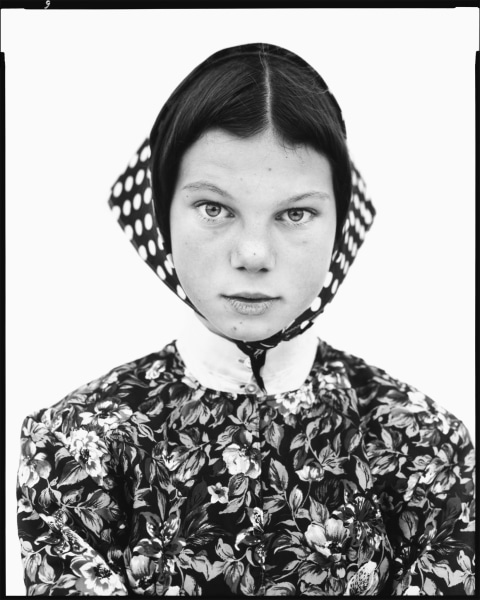
Richard Avedon
Freida Kleinsasser, thirteen-year-old, Hutterite colony, Harlowton, Montana, June 23, 1983
© The Richard Avedon Foundation
Courtesy Gagosian
-
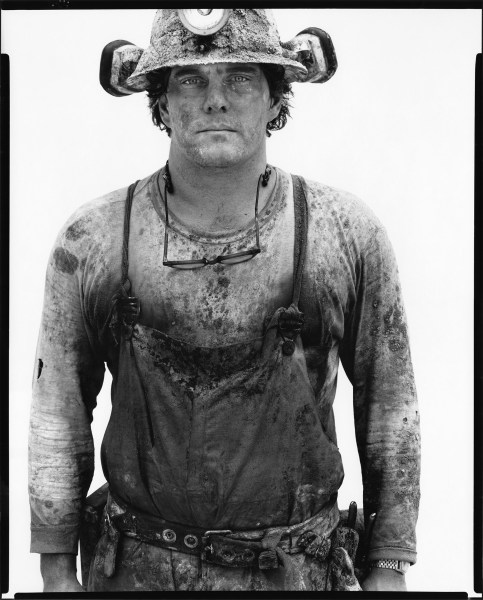
Richard Avedon
Joe Dobosz, uranium miner, Church Rock, New Mexico, June 13, 1979
© The Richard Avedon Foundation
Courtesy Gagosian
-

Richard Avedon
Roger Tims, Jim Duncan, Leonard Markley and Don Belak, coal miners, Reliance, Wyoming, August 29, 1979
© The Richard Avedon Foundation
Courtesy Gagosian


 View fullsize
 View fullsize
 View fullsize
 View fullsize
 View fullsize
 View fullsize
 View fullsize
 View fullsize
 View fullsize
 View fullsize
 View fullsize
 View fullsize
 View fullsize
 View fullsize
 View fullsize
 View fullsize
 View fullsize
 View fullsize
 View fullsize
 View fullsize
 View fullsize
 View fullsize
 View fullsize
 View fullsize
 View fullsize
 View fullsize
 View fullsize
 View fullsize
 View fullsize
 View fullsize
