Drawn by the beauty of evil, the magic of the lower depths, having taken pictures for my ‘voyage to the end of night’ from the outside, I wanted to know what went on inside, behind the walls, behind the façades, in the wings: bars, dives, night clubs, one-night hotels, bordellos, opium dens. I was eager to penetrate this other world, this fringe world, the secret, sinister world of mobsters, outcasts, toughs, pimps, whores, addicts, and [sexual] inverts.
-- Brassaï
 View fullsize
Fille de Montmartre playing Russian billiards, Blvd Rochechouart, 1932-33
 View fullsize
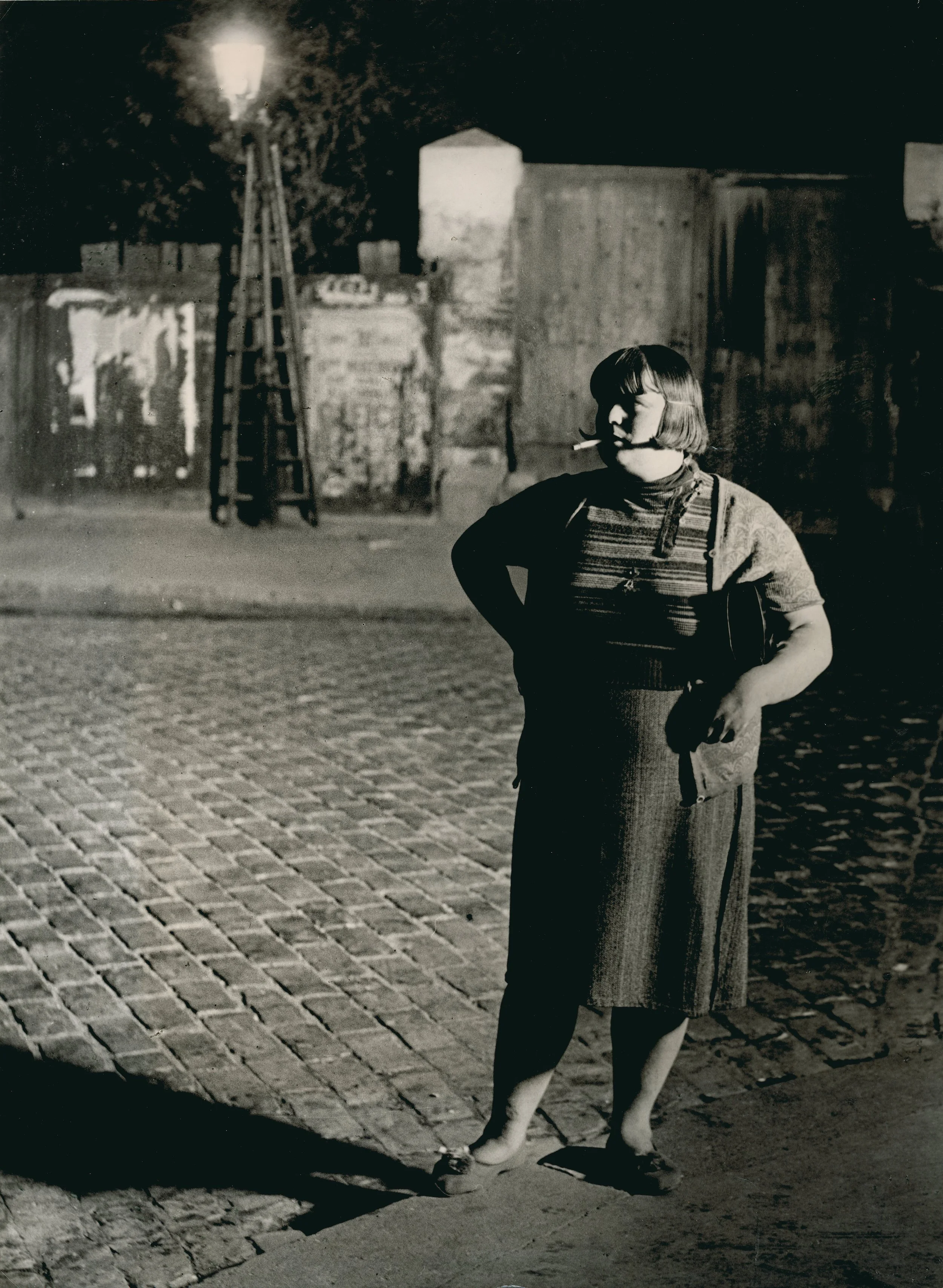
Streetwalker near the Place d'Italie, Paris, 1932
 View fullsize
The ballerina Ludmilla Tcherina backstage, Sarah Bernhard Theater, 1945
 View fullsize
Lovers, Bal Musette des Quatre Saisons, rue de Lappe, ca. 1932
 View fullsize
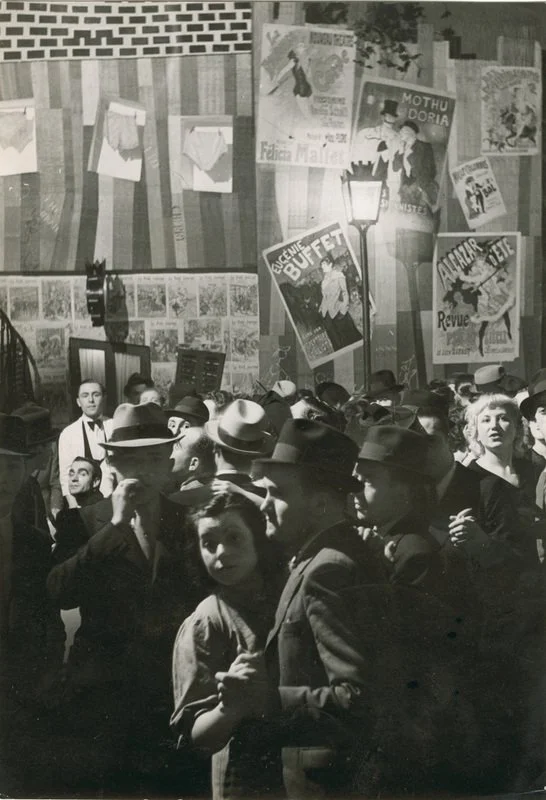
“Le Balajo” dance hall, rue de Lappe, 1936
 View fullsize
Trees, with the Pont Neuf, ca. 1932
 View fullsize
Madame Bijou in the Bar de la Lune, Montmartre, 1932
 View fullsize
Transmutation: Temptation of Saint-Antoine. 1934-35
 View fullsize
At Suzy’s, the presentation, ca. 1932
 View fullsize
Lovers, Bal Musette des Quatre Saisons, rue de Lappe, ca. 1932
 View fullsize
Fog, avenue de l'Observatoire, 1934
 View fullsize
Chez Suzy (fille de joie in mirror), 1932
 View fullsize
Passage de Cloute, rue de Rivoli, 1937
 View fullsize
Paris from Notre Dame, ca. 1933
Early 20th century Paris was the setting for one of the great flowerings that have periodically punctuated the history of photography. As with painting and sculpture, ambitious young photographers from around the world flocked to between-the-wars Paris, where they formed a fertile artistic milieu. Among them was the Transylvanian-born Brassaï, whose evocative, inky-black, and very rare, vintage photographs of night-time Paris from a private collection are assembled into this unforgettable exhibition.
How appropriate that Brassaï – the most acclaimed artist ever to emerge from Transylvania – is best known for his photographs of Paris’s notorious creatures of the night! After attending art school in Berlin, Brassaï moved to Paris in 1924, and stayed for good. Born Gyula Halász, he adopted the nom de plume Brassaï from his birthplace, Brasso, a Hungarian (now Romanian) town in the Transylvanian region. A gifted sculptor and sketch artist, he learned the technical aspects of photography from his fellow Hungarian-in-Paris André Kertész, but the two artists’ subject matter could not have been more different. In contrast to Kertész’s cool compositions and meticulous still lifes, Brassaï focused on Paris’s crepuscular demimonde, which he explored compulsively from the first moment of his arrival. Sometimes alone, sometimes accompanied by friends like the writers Henry Miller or Jacques Prévert, Brassaï witnessed aspects of Parisian night life that the cerebral Kertész would never imagine.

No comments:
Post a Comment